Book Review: Youth Culture 101, by Walt Mueller
If you work with middle school to college kids, you need to get this book. Walt Mueller has presented in this book the finest outline of youth culture today, aptly applying psychology, sociology and theology into such an overview that you would be impoverished to pass this one up. He is the founder and president of the Center for Parent/Youth Understanding, and is a 30-year veteran of youth ministry.
 This book gives the best overview of youth culture today. Irreplaceable!What do I like about this book? I think Mueller was on the right track to not specify his research and writing too much so as to render it obsolete quickly, but rather he identifies big cultural trends and undercurrents of thought and behavior that characterize youth culture. Much of his attention is on media and marketing, as they are the primary shapers of young people. As the digital age continues to sweep over us, entertainment and the values it proposes to us are perpetually accessible. Whereas in yesteryear it was costly and rare to be entertained, today we have instant access to a virtually unlimited music, television, and movie catalogue for less than a dollar (or free with online piracy).
Book Review: A New Kind of Youth Ministry, by Chris Folmsbee
Chris Folmsbee, the director of Barefoot Ministries, is growing in popularity and impact among emergent church ministers, and this book is one of the reasons why. In A New Kind of Youth Ministry, you will not find pages of neat new tricks you can use in your program, tools to make bigger events, and techniques for being edgier. In fact, this book is the antidote to such thinking.
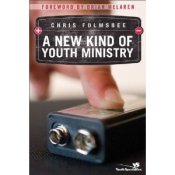 Not a bag o' tricks, just good intentions to challenge the idolatry of the status quo.This is a book about intentions. It contains holy intentions for true and lasting change. It offers new foundations for youth work, new approaches and practices, and an overhaul of the goals for so-called "successful youth ministry."
The purpose of the book is to get each youth minister to reculture his or her current ministry.
Book Review: Iraq, The Moral Reckoning, by Craig M. White
He believes that such important matters needed slow, careful and rigorous examination, but what was often being churned out was too simplistic, lacking due seriousness to the claims of the Bush Administration for meeting the criteria of just war, despite rhetoric to the contrary. White's hope was to debate the authors of First Things, notably Neuhaus himself and George Weigel, who took a pro-war stance.
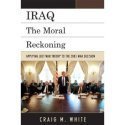 Iraq, The Moral Reckoning, is required for every U.S. CatholicIraq, the Moral Reckoning is a rigorous analysis and application of the six criteria of Just War Theory to the 2003 decision by the Bush White House to go to war against Iraq. The subtitle of this book is important, for the author does not want to do what many critics of the Bush Administration have done, which is to look at all of the mistakes from 2003 - onward and say that, with 20/20 hindsight, this was an unjust war. His book is meant to analyze the decision, not the aftermath, of going to war. He treats the Jus Ad Bellum ("Right to wage War"), rather than the Jus in Bellum ("Rightness in War"), which means that the information that was available at the time of the decision and the justifications given for the decision, and not later information or re-justifications, are the data for his analysis.
Biblical Interpretation: Catholic Response
Biblical fundamentalism fails the Catholic Church’s vision of Scripture and exegesis because it is anti-science, anti-authorship and ahistorical. As an ideology, fundamentalism rejects any science as a force undermining the Christian faith. The natural sciences refute the ancient cosmology and Creation stories, while historical criticism demonstrates the development of the inspired text, denying their doctrine of strict verbal inspiration, and consequently, of total inerrancy. And so, despite its ability to bear good exegetical fruit, it is rejected from root to tip as valid tools for the biblical fundamentalist.
The Catholic Church, on the other hand, has never rejected the ability of human reason to know truth, affirming reason and faith, being neither rationalist nor fideist. Within this appreciation of human reason, comes the legitimization of the sciences: natural, social, and literary. Historical criticism was rejected initially by the Church in Pope Leo’s encyclical Providentissimus Deus, because it was attached to a “much too intrusively dogmatic liberalism” that was buttressed by rationalism and modernism (IBC: 28). Through Catholic exegetes making careful use of these critical methods, the Church, in freeing the methods from unacceptable presuppositions, fifty years later allowed her exegetes to make use of this criticism wisely in the papal encyclical Divino Afflante Spiritu. In her cautious approach to ‘higher criticism’, she was able to avoid many of the abuses of liberal Protestant exegetes that the fundamentalists reacted against so strongly.
Biblical Interpretation: Fundamentalism
Many Christians view the use of scientific methods in the interpretation of Scripture with hesitation or even hostility because they see such criticism undermining the traditional authority of the Bible. Rejecting the scientific methods altogether, some turn to biblical fundamentalism in order to safeguard their understanding of the Bible as inspired and inerrant. This post addresses the claims of biblical fundamentalism, what it is and why is it inconsistent with the Catholic approach to the Bible itself and to biblical interpretation.
This post deals first with a brief treatment of the fundamentalist ideology, followed by their conception of inspiration and inerrancy. The reader will understand how the fundamentalist, operating within their ideological world view, must reject diachronic methods of interpretation. Finally, the next post that I will do will treat the Catholic vision of the Bible and its interpretation in order to show biblical fundamentalism is inconsistent with the Church’s model of exegesis.