Start here.
I have written here since 2010 on evangelization, parish life, Scripture, apologetics, and the moral life. These six are the best place to begin.
Go Home and Live as Missionary Disciples
If your faith feels humdrum, you may not have entered the mission yet. A talk to men on what that asks of you.
Formed By Distraction
Eliot described minds pulled from one distraction to the next. We now carry that in our pockets. What is it forming in us?
What Is a Catholic?
A plain answer: who belongs to the Church Christ founded on the Apostles, and what holds that Church together.
Why You Need Your Men’s Group
Before asking whether men’s groups work, ask what problem they are meant to solve.
Why Protestants Are Becoming Catholic at My Parish
What draws evangelicals and mainline Protestants into the Catholic Church, as they told me in class.
How God Speaks in Human Words
The first of four articles on how the Bible is at once a human book and the Word of God.
(article) human love in the divine plan
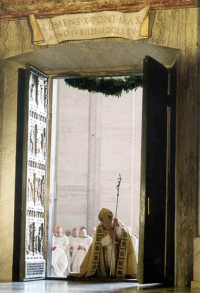 If there was one essential point to the Theology of the Body that Pope John Paul II gave in his Wednesday Audiences over the period of five or so years, that I could distill out and give to you today, it would be this: the whole human person, soul and body, is caught up in the beautiful drama of love and life.
Love is more than just feelings, than a stirring of the senses and the thrill of physical touch. It is so much more than that, but it sure wouldn’t be the same without all that! God did not create us to be angels, but man, male and female. We have bodies, with goose-bumpy skin, responsive nerve endings, and hormone tidal waves that could overwhelm a giant.
But not Pope John Paul II, a man who never knew the marriage bed. He tells us the truth.
What I learned at Lunch about the Love of Jesus Christ
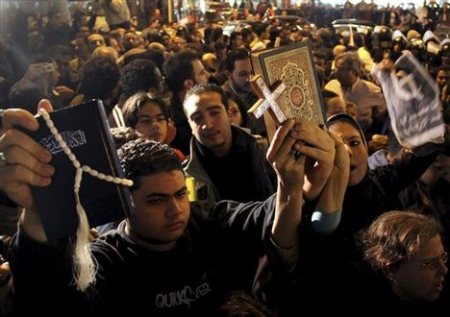 The protestors were united against a brutal regime, and they achieved solidarity in and through their faith, not in spite of it. Learn that lesson!He even got to speak on contemporary issues, especially what's going on in Egypt right now. He showed us a picture of an Egyptian Coptic Orthodox man holding up a cross next to a Muslim holding up the Koran, and how they are holding each other's hands. It was a gesture of solidarity.
Something fascinating and under-reported: in the midst of the protest, the Muslims cleared a path for the Christians to gather and to celebrate Mass and the Christians made room so that the Muslims could pray.
I don't evangelize. I'm Catholic.
 Intro: I got it all wrong
Evangelization, evangelism and evangelical are all pretty much Protestant words for most American Catholics today. I considered myself one of those Catholics for a while. Catholics did not preach on street corners, did not pass out pamphlets, and did not knock on doors to spread the Gospel. If we did anything, the most we did was toss in the collection plate a few bucks on Mission Sunday in order to donate to those religious orders who were taking the Gospel to strange lands on the otherside of the world. Not the average pew-sitter's vocation.
Evangelization Before Catechesis
I talk a lot about the new evangelization and approaches that we take here at LayEvangelist.com that are based upon the new evangelization, but it occurred to me that some people might not understand what is so different about this approach than others.
In typical parish-based catechesis in the past it was safe to assume that parents knew the faith and were communicating it to their children and that, at least to some point, the culture was by-and-large supporting the Church's moral vision, and things like the Rosary and mass attendance were just another part of the average Catholic's life.
These assumptions can no longer be made, yet it seems that so much of our theology curricula come from this perspective.
Catechesis and Holiness
One's holiness is dependent upon their discipleship, which may depend on our catechesis! Thus the Pope starts out his section on the integrity of the content with these words in CT 30:
"In order that the sacrificial offering of his or her faith should be perfect, the person who becomes a disciple of Christ has the right to receive 'the word of faith' not in mutilated, falsified or diminished form but whole and entire, in all its rigor and vigor."
We cannot be mistaken here. As a catechist you bear awesome responsibility that echoes loudly into eternity. Catechesis that mutilates parts of the deposit- for whatever reason- interferes with the disciple's ability to be conformed to the likeness of Jesus Christ. This affects worship, the "sacrificial offering" of ourselves!