The question
I recently asked a room of students a simple question: Are you your body, or do you merely have a body? We came to the question through Plato's dialogue the Meno. The room split. Some said they are their soul and use a body. Others said they are their body and nothing more. One student said, "I am not my body, but my body is me." That last answer was the closest to the Catholic position than any of the others.
In the Meno, Socrates calls over a slave boy who has never studied geometry. He draws a square two feet on each side and asks the boy how to make a square with double the area. The boy first guesses that he should double the length of each side. Socrates shows the boy that this produces a square four times the size. The boy then tries a side one and a half times as long, and that also fails. Finally, Socrates draws a line from corner to corner, the diagonal, and shows that a square built on the diagonal has exactly double the area of the original (Meno 82b to 85b).
Socrates never told the boy the answer. He only asked questions. The boy reached a geometric truth he had never been taught. Socrates draws a large conclusion from this small lesson.
Socrates: learning is recollection
He concludes that the boy did not learn anything new, but rather that he remembered it. The Greek word is anamnesis, or in English, Recollection. We still use the same idea when we say we "recognize" someone. To re-cognize is to know again. Recollection requires a soul that knew things before it entered the body, as Socrates says in the passage just before the geometry lesson. He reports what “certain priests and poets” teach: the soul is immortal, it comes to an end in what we call death, it is born again, and it is never destroyed. Because it has been born many times and has seen all things in this world and in Hades, there is nothing it has not learned. Learning in this life is therefore the soul recalling what it already knows (Meno 81b to 81d).
This means the Platonic Socrates (the Socrates of Plato’s dialogues may or may not represent the views of the original Socrates, Plato’s teacher) does teach rebirth.
This reincarnation returns in other dialogues. In the Phaedo, Socrates argues from an ancient teaching that souls pass from this world to the next and return again (Phaedo 70c to 72e), and he describes impure souls being reborn into animal bodies (Phaedo 81d to 82b). The Republic ends with the Myth of Er, in which souls choose their next lives before drinking from the river of forgetfulness (Republic X, 614b to 621d). For Plato, the moral life still matters, because what a soul does in one life shapes the life it receives next. But the soul passes through many bodies.
Scholars today debate how much of the reincarnation doctrince belonged to the historical Socrates and how much to Plato. For our purposes, the dialogues teach a soul that exists before birth, knows before it learns, and returns to bodies again.
This view has a cost that many who buy into reincarnation do not generally think about. If the soul existed and knew everything before it had a body, then the body adds nothing to who I am. Worse, the body gets in the way. In the Phaedo, Socrates says the body fills us with desires and distractions that keep us from seeing the truth, and that the philosopher should practice separating the soul from the body (Phaedo 64c to 67d).
Greek philosophy ranks the soul as higher and the body as lower, with the animals, and Christians later used a good deal of that ranking, too, though sometimes without noticing what extra baggage came with it.
Where the soul saw the Forms
Plato says that what the soul knew before birth was the Forms. A Form is the perfect, unchanging reality that many particular things share in. Many things are beautiful, but there is the Beautiful itself. Many sticks are equal in length, but there is the Equal itself. In the Phaedo, Socrates ties recollection directly to the Forms. We see two sticks that are nearly equal, and that reminds us of the Equal itself, which we must have known before we were born (Phaedo 74a to 76e). In the Phaedrus, souls travel in procession and behold the Forms in a place beyond the heavens before falling into bodies (Phaedrus 247c to 249c).
It is common to say that the Forms are ideas in the mind of God. That is not Plato's view. For Plato, the Forms are not in any mind. They exist by themselves, eternal and unproduced. In the Timaeus, the divine craftsman who makes the world looks to the Forms as a model outside himself (Timaeus 28a to 29a). In the Parmenides, the young Socrates suggests that a Form might be only a thought in a soul, and Parmenides refutes him (Parmenides 132b to 132c).
The move to place the Forms inside God came later. Middle Platonists in the centuries around the time of Christ began to speak of the Forms as the thoughts of God. Philo of Alexandria, a Jewish contemporary of Jesus, placed them in the divine Word, the Logos (On the Creation of the World 17 to 20). Augustine then gave the idea its classic Christian form. He taught that the ideas are the stable reasons of things, held in the divine mind itself, according to which God creates (Eighty-Three Different Questions, q. 46). Thomas Aquinas affirmed the same teaching and explained it (Summa Theologiae I, q. 15, a. 1).
This change matters for our question. Once the Forms are God's own ideas, they are not a separate realm where souls lived before birth. They are the plan by which God creates each thing. Augustine saw the consequence. He rejected the soul's pre-existence and read the Meno differently. The slave boy answered correctly, Augustine said, not because he remembered a former life, but because God made the mind to see intelligible truths by a unique kind of incorporeal light, as the eye sees bodies by the light of the sun (On the Trinity XII.15.24). Augustine kept Plato's insight that truth is above us and found within. He dropped the claim that we lived somewhere else first.
The spectrum
The answers my students gave fall along a line. At one end, I am only my body. At the other end, I am only spirit, and the body is unreal. The Catholic position sits between them, and it is not a compromise. It holds that the body and the soul together are the one person.
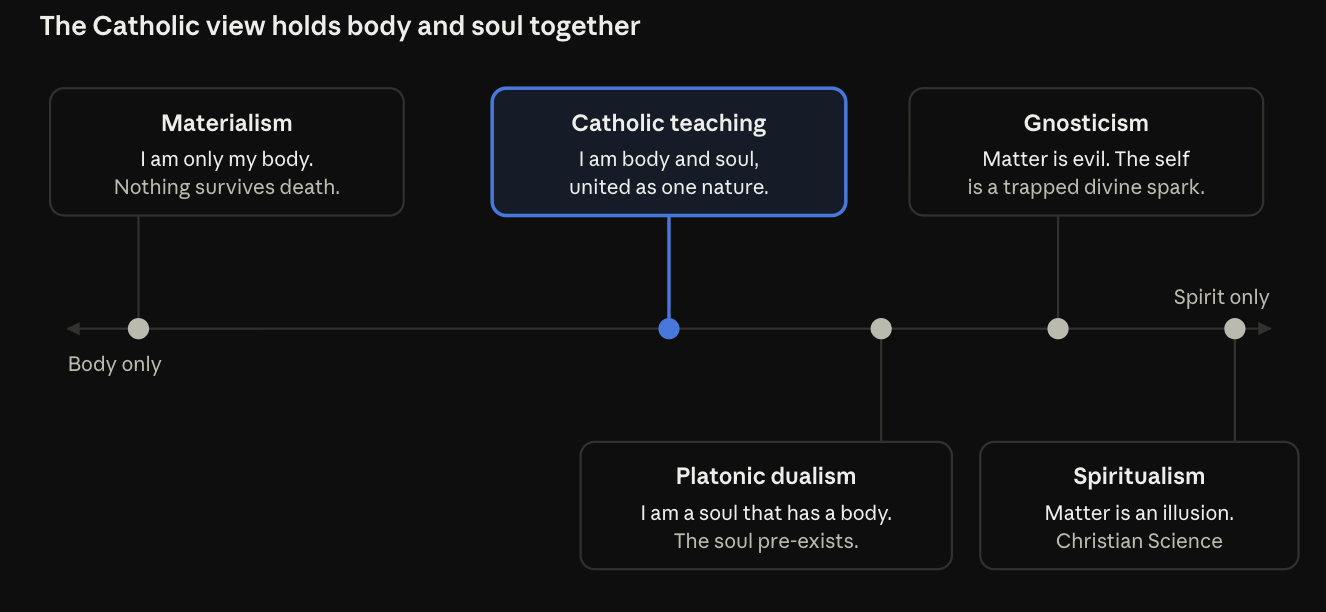
A spectrum of views, with Catholic teaching honestly in the middle.
Materialism says there is no soul, no spirit, and no God. When I say "I," I mean a living body and nothing more. At death, the person ends.
Platonic dualism says I am my soul, and I have a body. The soul existed before birth among the Forms, knows before it learns, and may pass into other bodies.
Gnosticism goes further. The Gnostics of the second century taught that two gods exist. A lesser god made the material world, and they identified him with the God of the Old Testament. The true, higher God is pure spirit. Salvation comes through secret knowledge, gnosis, that frees the divine spark inside a person from the prison of matter. Some Gnostic groups even honored the serpent in Eden as a liberator. St. Irenaeus wrote Against Heresies around AD 180 to answer them, and they were among the most serious threats the early Church faced.
Spiritualism, in the sense I am using it here, says matter is not real at all. Mary Baker Eddy, the founder of Christian Science, taught this in Science and Health (1875). Some Hindu and Buddhist schools also teach that the material world is an illusion to be seen through.
Catholic teaching says the human person is "a being at once corporeal and spiritual" (CCC 362). The soul is not a passenger in the body. It is the form of the body, the principle that makes this matter a living human body. Body and soul do not form two natures joined together. Their union forms a single nature (CCC 365).
The further a view moves to the right, the less the body matters. The further it moves to the left, the less the soul matters. Only the center can say that I am this body and also more than this body.
What the Old Testament says
Before we hear the Catholic answer, we should notice how different the Old Testament sounds from Plato. For most of the Old Testament, the great good is this embodied life. The dead go down to Sheol, a shadowy place where they persist as weakened "shades." The psalmist argues with God on that basis:
"Dost thou work wonders for the dead? Do the shades rise up to praise thee? Is thy steadfast love declared in the grave, or thy faithfulness in Abaddon?" (Psalm 88:10 to 11, RSVCE)
The argument is simple. If I die, I cannot praise you, so keep me alive. Life is the highest good the psalmist can name.
Psalm 63 breaks that pattern. It is the one place in the Hebrew Bible that names a good better than life:
"Because thy steadfast love is better than life, my lips will praise thee." (Psalm 63:3, RSVCE)
The Hebrew word for "steadfast love" is hesed, God's faithful covenant love. In a world where life was the highest good, David says there is one good higher still, and it is God's love.
When the Old Testament does speak of hope beyond death, it first speaks of the body. Daniel says that many who sleep in the dust of the earth will awake (Daniel 12:2). The mother and her seven sons in 2 Maccabees die trusting that God will raise them up and restore their bodies (2 Maccabees 7).
The Book of Wisdom then introduces immortality thoroughly. It was written in Greek, most likely in Alexandria, in the century or so before Christ. It is one of the seven books in the Catholic Old Testament that are not in the Hebrew Bible or the Protestant canon. Its author knew the Greek philosophical world and spoke to it. In chapter 2 he gives voice to the materialists of his day:
"For they reasoned unsoundly, saying to themselves, 'Short and sorrowful is our life, and there is no remedy when a man comes to his end, and no one has been known to return from Hades. Because we were born by mere chance, and hereafter we shall be as though we had never been . . .'" (Wisdom 2:1 to 2, RSVCE)
Then he answers them:
"For God created man for incorruption, and made him in the image of his own eternity, but through the devil's envy death entered the world, and those who belong to his party experience it." (Wisdom 2:23 to 24, RSVCE)
"But the souls of the righteous are in the hand of God, and no torment will ever touch them. In the eyes of the foolish they seemed to have died, and their departure was thought to be an affliction, and their going from us to be their destruction; but they are at peace. For though in the sight of men they were punished, their hope is full of immortality." (Wisdom 3:1 to 4, RSVCE)
Wisdom also contains two passages that sound close to Plato, and they should not be skipped:
"As a child I was by nature well endowed, and a good soul fell to my lot; or rather, being good, I entered an undefiled body." (Wisdom 8:19 to 20, RSVCE)
"For a perishable body weighs down the soul, and this earthy tent burdens the thoughtful mind." (Wisdom 9:15, RSVCE)
Commentators debate whether the author meant to teach that the soul existed before the body. Two things keep the passage from carrying Plato's full doctrine. First, the author never says the soul knew anything before birth or passed through other lives. His point is that the soul has priority and that wisdom is God's gift, which he prays for in the very next verse (Wisdom 8:21). Second, the Church has never read the verse as teaching pre-existence, and she rejected that teaching when the followers of Origen promoted it. Wisdom gives us the language of an immortal soul. It does not give us Plato's account of where the soul came from.
The Catholic answer: I am body and soul
Suppose I walk up to someone and punch them in the face. When they file a police report, they will not write, "Mr. Gormley punched the body I happen to use." They will write, "Mr. Gormley punched me." Ordinary speech points toward the truth here, though it cannot prove it by itself. One of my students objected that we also say "he crashed into me" when someone hits our car. The difference is that I can step out of my car and leave it behind. While I live, I cannot step out of my body.
The Church gives that instinct a precise form. The Catechism teaches that "the unity of soul and body is so profound that one has to consider the soul to be the 'form' of the body" (CCC 365). The soul is what makes this matter a living human body. The body is the visible person.
The Church also teaches that "every spiritual soul is created immediately by God," that it is not produced by the parents, and that it is immortal. It does not perish when it separates from the body at death, "and it will be reunited with the body at the final Resurrection" (CCC 366). God does not pull my soul from a storehouse of souls that lived before. He creates it for this body, and the Church holds that human life must be protected absolutely from the moment of conception (CCC 2270).
This tells us what death is. Death is the separation of soul and body. The soul lives on and can enjoy the vision of God, which the tradition calls the beatific vision. But the person is not complete. Thomas Aquinas wrote: anima mea non est ego, "my soul is not I" (Commentary on 1 Corinthians 15, lecture 2). A soul without its body is not the whole person. The story ends only at the resurrection of the body, when "the last enemy to be destroyed is death" (1 Corinthians 15:26, RSVCE).
That is why we say in the Creed, "I believe in the resurrection of the body." It is why the Church buries the dead with reverence and counts burial among the corporal works of mercy (CCC 2300). An old custom laid Christians in their graves with their feet toward the east, so that they would rise facing Christ when he returns like the sunrise. The custom is symbolic, but the faith behind it is not. The body matters, and God intends to raise it.
It also explains why the Church rejects reincarnation. The Catechism teaches, "There is no 'reincarnation' after death" (CCC 1013), and it cites Hebrews: "And just as it is appointed for men to die once, and after that comes judgment" (Hebrews 9:27, RSVCE). If I am my body and soul together, and my soul is this soul because it is the form of this body, then another body would not be another life of mine. It would be someone else.
This question is not only ancient. Many people today say the real self is consciousness, and that consciousness could be carried by any material, flesh or silicon, or float free of matter altogether after death. That view treats the body as replaceable hardware. It is Plato's position in modern dress, and the Catholic answer to it is the same: I do not merely have a body. I am my body, animated by a soul God made for it.
Why her version of reincarnation empties the Gospel
Some years ago, a woman called me out of the blue and said she wanted to become Catholic. We met for coffee. She told me she had discovered St. Francis of Assisi, then read the Gospels, and found herself drawn to Jesus. For an hour she asked good questions, and I answered them as best I could. Then she asked where the Church stood on reincarnation.
I told her the Church rejects it. She was horrified.
I asked her why a soul would need to be reincarnated. She said it was because the person had not done well in the previous life, so God gives a second chance, or a third, or a thousandth. Then I asked her how a person finally gets into heaven. She said, "By being morally perfect."
That answer is the problem. If I reach heaven by perfecting myself over many lifetimes, then I am saved by what I accomplish, not by what Christ accomplished for me. Jesus becomes one more good teacher among many. History has plenty of philosophers and saints. I do not need another example. I need a Savior. Christianity is grace, a sheer gift that God gives in Christ. Reincarnation turns it into a long self-improvement program, and a moral program without grace is a knockoff of Christianity.
Other versions of reincarnation do not depend on earning heaven, but they all meet the problem described above. The soul is the form of one body, and a soul placed in another body would make another person. The Catholic view raises the stakes of this one life. We live once and die once, and then comes judgment (Hebrews 9:27). Purgatory is not a new life in a new body. It is the purification of this same person, finishing what grace began. And at the end, God does not discard my body for a better one. He raises this body, transformed, so that the whole person shares in his life. The doctrine that refutes reincarnation is spoken by us every time we say the Apostles' Creed: the resurrection of the body. Which body will rise if I have lived in a thousand bodies?
At the end of our conversation, she told me she was sorry, but she could not accept it because she had done some form of "past life therapy" and knew who she was in those previous existences. I respected her honesty, though it broke my heart. She grabbed her things and immediately left. Sad though it was, she know that becoming Catholic means accepting a new and whole way of seeing the world, which may mean that old perspectives one held on to must be let go. To do such a thing, a rational person needs sounds reasons to reject the one in order to accept the other.
So, are you your body, or do you merely have one? The answer is that you are a body and a soul composite or union, made by God as one person, living one life, and destined to rise whole. As one of my students put it, "I am not my body, but my body is me." He meant that I am not only my body, and that my body is truly me.
References
Scripture (Revised Standard Version, Catholic Edition)
Daniel 12:2
2 Maccabees 7
1 Corinthians 15:26
Hebrews 9:27
Plato
Meno 81b to 81d (recollection and rebirth); 82b to 85b (the slave boy)
Phaedo 64c to 67d (the body as hindrance); 70c to 72e (souls return); 74a to 76e (recollection of the Equal); 81d to 82b (rebirth into animals)
Phaedrus 247c to 249c (souls behold the Forms)
Republic X, 614b to 621d (the Myth of Er)
Timaeus 28a to 29a (the craftsman's eternal model)
Parmenides 132b to 132c (Forms are not thoughts)
Later writers
Philo of Alexandria, On the Creation of the World 17 to 20
Irenaeus of Lyons, Against Heresies (c. AD 180)
Augustine, Eighty-Three Different Questions, q. 46, "On the Ideas"
Augustine, On the Trinity XII.15.24 (English text)
Thomas Aquinas, Summa Theologiae I, q. 15, a. 1
Thomas Aquinas, Commentary on 1 Corinthians, ch. 15, lecture 2
Mary Baker Eddy, Science and Health (1875)
Catechism of the Catholic Church
CCC 362, 365, 366 (body and soul)
CCC 1013 (no reincarnation)
CCC 2270 (life from conception)
CCC 2300 (burial of the dead)